A Reference Primer on Drainage Systems in Mongaguá SP
This is a reference piece on how wastewater leaves a property in Mongaguá, on the coast of São Paulo, and where it goes before reaching the municipal network. It is meant to be read once and revisited: a structured primer covering internal traps, private laterals, inspection boxes, municipal connections, and the maintenance decisions that keep the whole chain working. If you need immediate help rather than theory, a professional desentupidora em Mongaguá SP can inspect the line and clear the blockage at its source.
The search intent behind this topic is mostly practical: residents and property managers want to understand why drains back up, what the different parts of the system are called, and when to call a specialist. The short answer is that most household blockages begin in the private stretch of pipe between the fixtures and the public connection, and that stretch belongs to the property owner, not the water utility. Understanding that boundary is the first step to solving recurring problems.
1. Scope: from the kitchen sink to the municipal collector
A drainage system is not a single pipe. It is a chain of components with different diameters, slopes, and responsibilities. On a typical residential lot in Mongaguá, wastewater moves from fixtures through branch lines, into a main private lateral, through inspection boxes, and finally into the public collector under the street. Each link has its own failure modes.
The chain matters because a blockage in one segment can look exactly like a blockage in another. Water rising in a floor drain may come from a clogged branch line a few meters away, or from a full inspection box at the front of the lot. Diagnosing the location is as important as clearing the obstruction.
- Fixture traps keep sewer gas out of the room and catch the first debris.
- Branch lines carry waste from sinks, showers, and toilets to the main lateral.
- Inspection boxes provide access for cleaning and for checking flow direction.
- Private lateral runs from the lot boundary to the public collector.
- Municipal collector is maintained by the local utility or municipality.
2. Internal traps and the water seal
Every drain connected to the sewer should have a trap, a U-shaped section that holds a small amount of water. That water seal is the barrier that stops sewer gases from entering the building. When a trap dries out, usually because a fixture is rarely used, odors appear even though the pipe is not blocked.
Traps also collect debris. Hair, soap residue, grease, and food particles settle in the low point and gradually narrow the passage. A slow drain is often the first sign that a trap or the branch line behind it is accumulating material. Ignoring it usually leads to a full blockage later.
Common trap mistakes
Two mistakes recur in coastal homes. The first is pouring chemical drain cleaners repeatedly into a slow drain; these products can damage older pipes and rarely remove the full obstruction. The second is removing or bypassing a trap to improve flow, which solves nothing and allows odors into the property.
3. Branch lines, slopes, and the private lateral
Branch lines rely on gravity, which means slope matters. A pipe laid with too little fall allows solids to settle; too much fall can cause water to run ahead and leave solids behind. In older properties, settled soil or inadequate original installation can create low spots where debris accumulates.
The private lateral is the stretch most often forgotten. It runs from the inspection box near the building to the connection at the lot boundary. Roots, grease, and collapsed joints are common causes of failure here. Because this section is private, responsibility for clearing and repairing it rests with the owner.
When the blockage is in this lateral, a technician typically uses a rotating cable or hydro-jetting equipment to restore full diameter. A camera inspection afterward confirms whether the pipe is clear or whether a defect needs repair.
4. Inspection boxes and access points
Inspection boxes, sometimes called cleanouts when they are vertical, exist so the system can be accessed without dismantling fixtures. A well-designed property has accessible boxes at changes of direction and near the lot boundary. If a box is buried under paving or a garden bed, routine maintenance becomes much harder.
During a service visit, the technician will open the nearest box and observe the water level and flow. A box that is full and slow to drain points to a blockage downstream; a box that is empty while fixtures back up points to a blockage upstream. This simple observation often saves time and avoids unnecessary excavation.
For property managers in Mongaguá, keeping a simple diagram of box locations is a practical investment. It shortens every future service call and reduces the risk of damage during cleaning.
5. The municipal connection and the boundary of responsibility
The point where the private lateral meets the public collector is the boundary between owner and municipality. Upstream of that point, the property owner is responsible; downstream, the utility or local authority is responsible. Misunderstanding this boundary is a frequent source of frustration during emergencies.
If wastewater backs up into the property while neighbors are unaffected, the blockage is usually private. If several properties on the same street are affected at once, the public collector may be the problem, and the municipality should be contacted. A qualified desentupidora Mongaguá can help determine which side of the boundary the obstruction sits on before any work begins.
In coastal areas, groundwater and heavy rain can also overload the system, causing backups that are not caused by a single blockage. In those cases, clearing the private line may restore flow temporarily, but the underlying issue is hydraulic capacity during storms.
6. Septic systems, grease traps, and coastal specifics
Not every property in Mongaguá is connected to a municipal collector. Some homes and small businesses rely on septic tanks and soak-away systems, which require periodic pumping and inspection. A septic system that is never maintained will eventually clog the drain field, and the repair cost is far higher than routine cleaning.
Commercial kitchens add another layer: grease traps. These devices intercept fats, oils, and grease before they reach the main line. If a grease trap is undersized or rarely cleaned, grease passes into the lateral and hardens, creating blockages that recur quickly.
| Component | Typical maintenance | Warning sign |
|---|---|---|
| Fixture trap | Clean when slow | Odor or sluggish drain |
| Private lateral | Inspect every few years | Multiple fixtures backing up |
| Inspection box | Check flow annually | Standing water in box |
| Septic tank | Pump on schedule | Slow drains throughout house |
| Grease trap | Clean regularly | Kitchen drains slow together |
Coastal humidity and sandy soil also affect buried pipes. Joints can shift, and salt-laden air accelerates corrosion in older metal components. These are reasons to prefer inspection over guesswork when a blockage recurs in the same place.
7. Diagnosis and clearing: what a professional actually does
A professional service follows a sequence rather than guessing. The technician first interviews the occupant about which fixtures are affected and when the problem started. Then they locate and open the nearest inspection box to observe water levels. From there, the method depends on the pipe diameter and the suspected cause.
- Confirm which fixtures are affected to narrow the location.
- Open inspection boxes and check flow direction and standing water.
- Use a rotating cable for small branches and short blockages.
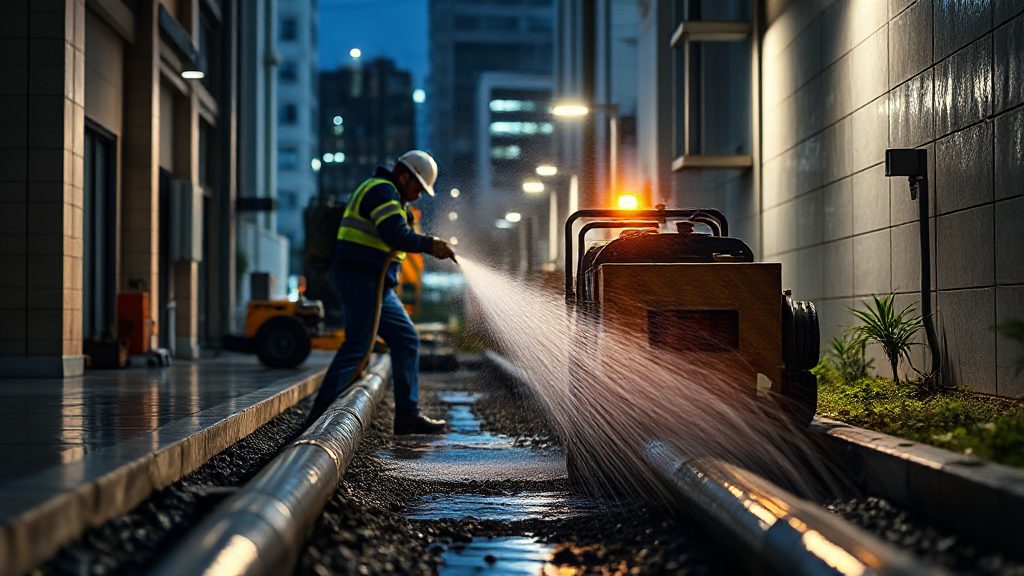
- Use hydro-jetting for grease, roots, and full-diameter cleaning.
- Run a camera inspection to verify the result and detect defects.
- Recommend preventive measures if the cause is likely to recur.
Hydro-jetting uses high-pressure water to scour the pipe walls, which removes grease and sediment that a cable alone can miss. Camera inspection is the difference between clearing a blockage and understanding why it formed. For recurring problems, the camera often reveals a broken joint, root intrusion, or a sagging section that needs repair.
Emergency service matters because sewage backups are a health issue, not just an inconvenience. When wastewater is rising into a property, the priority is to stop the flow and clear the line quickly. A desentupidora Mongaguá SP with 24-hour availability can respond outside normal business hours, when many blockages are discovered.
8. Prevention, costs, and a closing summary
Prevention is cheaper than repair. Avoid pouring grease down the sink, use strainers in showers and sinks, and keep inspection boxes accessible. In coastal properties, periodic inspection of the private lateral is worthwhile, especially in older buildings or after heavy rain events.
Costs vary with access, pipe diameter, and the method required. A simple branch-line clearing is at the lower end; hydro-jetting plus camera inspection costs more but provides a durable result and diagnostic information. Excavation or repair of a collapsed lateral is a separate category of expense and should follow a camera inspection, not precede it.
To summarize this primer: wastewater leaves a Mongaguá property through fixture traps, branch lines, a private lateral, and inspection boxes before reaching the municipal collector. The owner is responsible up to the boundary; the municipality beyond it. Most blockages start in the private stretch, and the most reliable diagnosis comes from opening boxes, observing flow, and using camera inspection when problems recur. Keep the diagram, keep the boxes accessible, and call a specialist when water rises rather than waiting for it to drain.